Why Small-Format Body Care Works in Thailand
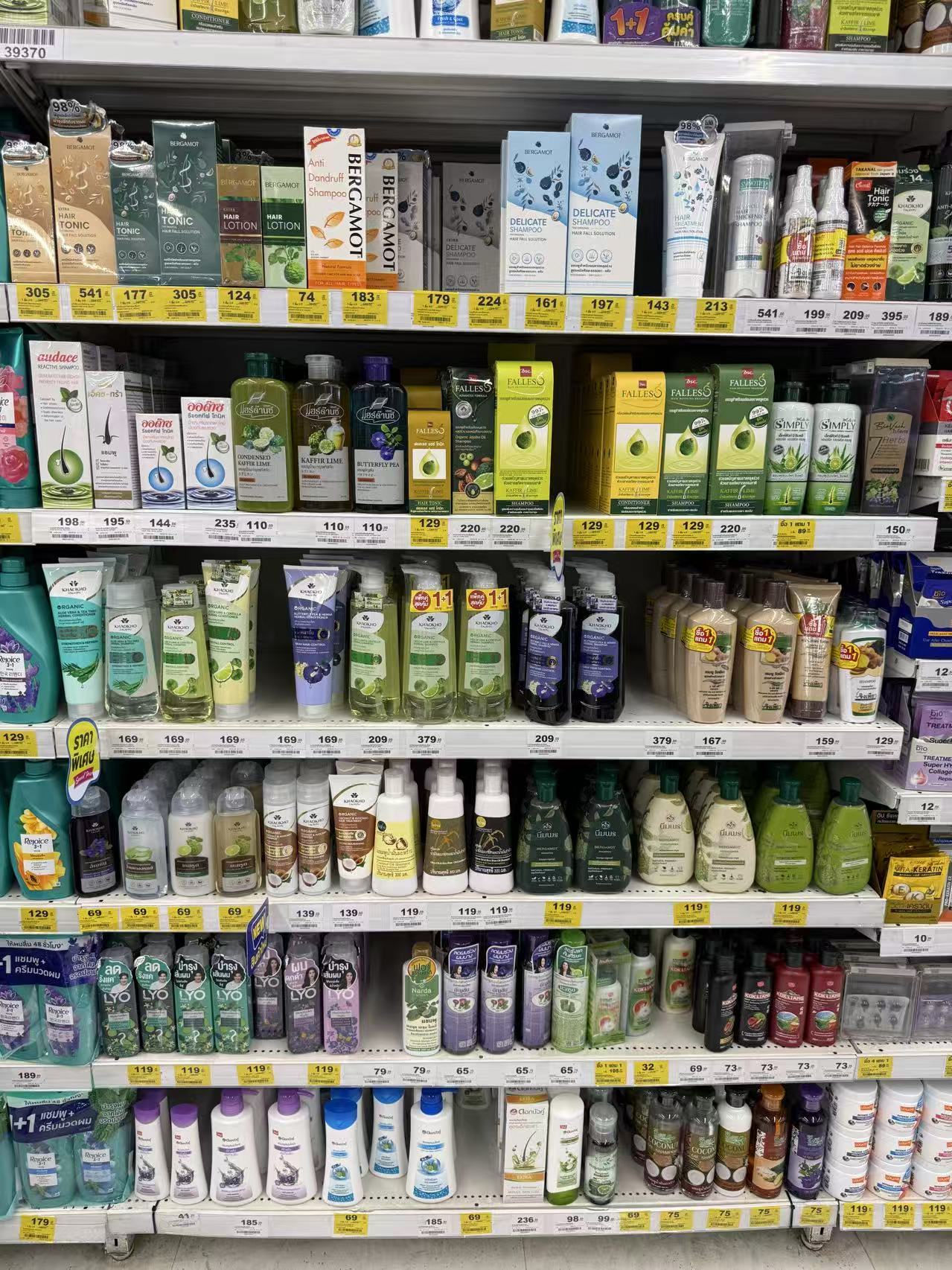
Thailand's retail landscape is unusual in one important respect: convenience stores are not a secondary channel, they are a primary one. With a dense network of 7-Eleven, Lotus's, FamilyMart, CJ Express and similar outlets, plus heavy tourist traffic in Bangkok, Phuket, Chiang Mai, Pattaya and the islands, shelf space is dominated by small packs.
For a buyer, this creates a specific sourcing problem. The SKU that sells in a European supermarket — a 500ml shower gel — is often the wrong unit for a Thai convenience store. What moves is the 30ml to 100ml bottle, the single-use sachet, the travel kit, the resealable wipe pack. Tourists and city commuters buy on impulse, on the way to a hotel or a gym, and they buy small.
This article is a sourcing checklist for importers, distributors and private-label brand owners building a small-format body care range for Thailand. It covers format selection, formulation, packaging, sampling, MOQ negotiation and export documentation.
Step 1: Define the Format Mix Before You Talk to Suppliers
Most sourcing problems start with a vague brief. Before requesting samples, decide the actual unit economics you need.
Formats that typically fit the channel
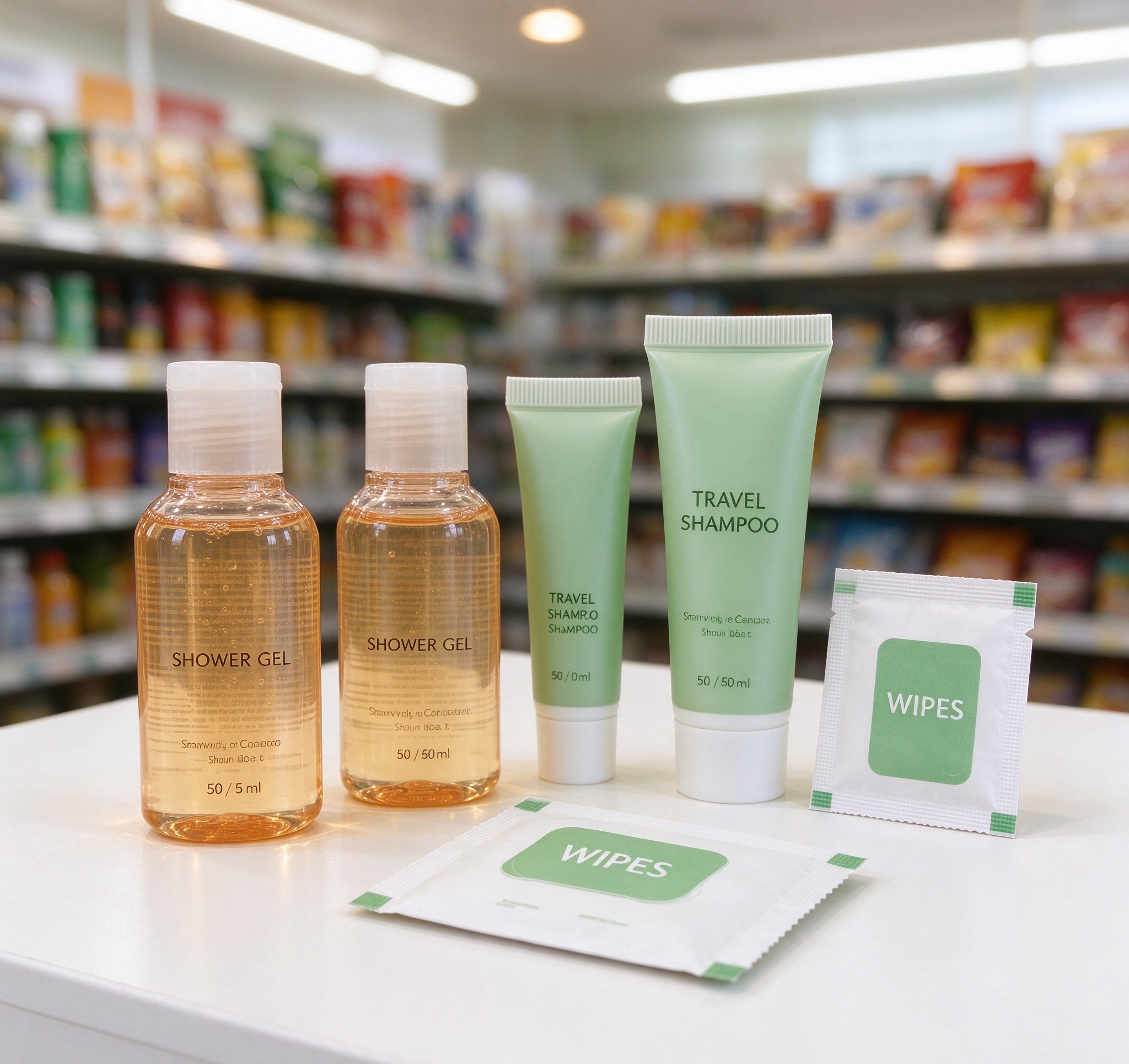
- Travel/trial bottles — 30ml, 50ml, 75ml, 100ml for shampoo, shower gel, conditioner and body oil.
- Sachets and pillow packs — single-use, low unit cost, good for basket-filler placement near the register.
- Wipe packs — disposable face towels and wet wipes in 10-, 20- and 30-sheet resealable packs, plus single-serve sachets for handbags and gloveboxes.
- Disposable and single-use items — travel toothbrushes, razors, cotton pads, and hotel-style amenity kits.
- Bundle kits — a pouch or zip bag containing 2–4 small items, positioned as a travel set or a gift.
Questions to answer internally first
- What is the target shelf price point, and what landed cost per unit supports it?
- Is the product sold as a single unit, a 3-pack, or part of a kit?
- Is it for Thai domestic shoppers, tourists, or both? Tourist-facing SKUs often justify bilingual or English-forward labeling.
- Will it hang on a peg, stand on a shelf, or sit in a counter display box?
Once these are fixed, the supplier conversation becomes a technical discussion rather than a fishing expedition.
Step 2: Formulation and Fragrance Choices That Survive a Small Pack
Small formats are less forgiving than large ones. A 50ml bottle has a much higher surface-area-to-volume ratio, and it may sit in a hot, humid shop or a beach bag for weeks. Formulation decisions that are cosmetic in a 500ml pack become functional in a 50ml pack.
- Viscosity stability — confirm the formula holds its texture across the temperature and humidity range the product will realistically experience in transit and on shelf.
- Fragrance load — a scent that reads as subtle in a large bottle can be faint in a small one. Ask for samples in the actual fill size, not just in a lab beaker.
- Preservative system — ask how the system was validated for the specific pack format and closure.
- Color and clarity — if the bottle is transparent, any haze or color drift is immediately visible to the shopper.
- Fragrance direction — for Thailand, fresh, citrus, floral and light aquatic profiles are common briefs. Send your supplier a written fragrance brief with reference products rather than describing a scent in adjectives.
If you are developing a private-label line, request a written formulation brief back from the supplier that restates your requirements. That document becomes your reference point for every subsequent batch.
Step 3: Packaging, Labeling and the Travel-Retail Reality
In a convenience store, packaging does the selling. There is no aisle browsing, no staff recommendation — the pack has to communicate in about two seconds.
Bottle and closure decisions
- Leak resistance — this is the single most common complaint in small formats. Specify the closure type and ask how it is leak-tested.
- Flip-top vs. screw cap vs. disc-top — flip-top is convenient but must survive being squeezed in a bag.
- Material and finish — PET, HDPE and recycled-content options are all worth discussing; clarify what is available for your volume.
- Label area — a 50ml bottle has very little printable surface. Plan the mandatory information and the brand mark before artwork begins.
Labeling content to plan for
- Thai-language mandatory information, if the product is sold in the domestic market — confirm current requirements with your importer or a regulatory consultant.
- Bilingual Thai/English panels for SKUs aimed at both locals and tourists.
- Ingredient list, net content, batch code, and manufacturer/importer details.
- Barcode placement that scans reliably on a curved small bottle.
If you are supplying a retail chain under its own brand, expect a brand style guide. Build artwork review time into your schedule — label approval is frequently the longest single step in a private-label project.
Step 4: Sampling — What to Ask For and What to Check
Sampling is where a supplier relationship is either validated or quietly abandoned. Treat it as a structured test, not a formality.
- Ask for samples in the actual intended pack format, filled to the intended volume, with a representative label or a printed mock label.
- Request two or three fragrance or formulation variants in the same format so you can compare side by side.
- Ask for the current sampling lead time in writing, and clarify whether it changes for custom fragrance or custom packaging.
- Ask what the sample cost is and whether it is credited against a future order.
- Ask for the latest test documentation available for the formulation — do not assume what exists; request it.
A simple sample evaluation sheet
- Appearance, color, clarity against the approved standard
- Texture and spreadability in the small format
- Fragrance intensity out of the bottle and after use
- Leak test after simulated transport
- Label adhesion and print legibility on a curved surface
- Closure function after repeated open/close cycles
Score each sample against the same sheet. It turns a subjective decision into a comparable one.
Step 5: MOQ, Order Structure and Consolidation
Small-format SKUs create a MOQ puzzle: unit volumes are lower per pack, but you may want several fragrances and several formats in one program.
- Ask how MOQ is calculated — per SKU, per fragrance, per pack format, or per order.
- Ask whether mixed-SKU orders are possible and how they affect pricing tiers.
- Clarify whether MOQ changes when you supply your own packaging or use a stock bottle with a custom label.
- Confirm the current MOQ and lead time with our sales team, since these vary by format and customization level.
- Discuss container loading early — small bottles are dense and cube out before they weigh out, so loading plans matter.
- If you are buying from more than one supplier, ask about consolidation and whether mixed loads can be arranged.
For a first order, many buyers start with a narrower range — two or three hero SKUs — prove sell-through in the channel, then expand. That approach also reduces your exposure if a fragrance or format underperforms.
Step 6: Quality Consistency, Documentation and Reorders
A first shipment is a sample of your supplier's process. The second and third shipments are the real test.
- Golden sample — keep a sealed, signed reference sample from the approved batch. Every later batch is compared against it.
- Batch records — ask what documentation accompanies each production batch.
- Inspection — agree in advance whether pre-shipment inspection is done internally, by a third party, or by your own agent.
- Export documentation — confirm who prepares the commercial invoice, packing list, certificate of origin, and any product-specific certificates your market requires. Clarify responsibilities in writing before the order is placed.
- Change notification — ask for written notice before any change to formula, fragrance, packaging supplier or closure type. Undisclosed changes are the most common cause of failed reorders.
Put all of this in your purchase agreement or a simple quality annex. It is not bureaucracy; it is the thing that lets you reorder without re-checking everything.
Bringing the Range Together
Thailand's convenience store channel rewards buyers who think in small units and fast turns. The sourcing work is not complicated, but it is sequential: define the format mix, lock the formulation and fragrance brief, design the pack for a two-second read, evaluate samples against a written sheet, structure the order around realistic MOQs, and protect consistency with a golden sample and clear documentation.
Get those six steps right and you have a range that fits the shelf, the shopper and the tourist — and a supplier relationship that survives the second order.
Ready to build a small-format body care range for Thailand? Review our product and OEM/ODM capabilities or send us your format list and target price points and we will come back with a sampling plan.