Why Pair Canton Fair With Factory Visits in Guangdong
The Canton Fair gives buyers a fast way to meet many suppliers under one roof, but booth conversations only tell part of the story. For personal care and household consumables — shampoo, shower gel, body scrub, conditioner, body oil, disposable face towels, laundry detergent — the real due diligence happens when you see the production environment, sample room and packing lines yourself. Guangdong province concentrates a high density of daily-chemical and household-goods factories, and many are within a few hours of Guangzhou. A five-day itinerary lets you use the fair for first contact and then verify the shortlist on-site before you commit to sampling or private-label discussions.
This itinerary assumes you arrive in Guangzhou, spend one day at the fair, and then travel to one or two factory clusters. It is written for importers, distributors and private-label brand owners who need specifics, not sightseeing. Adjust the sequence to your flight times and your own shortlist.
Day 1 — Arrive, Set Up, and Pre-Qualify Your Shortlist
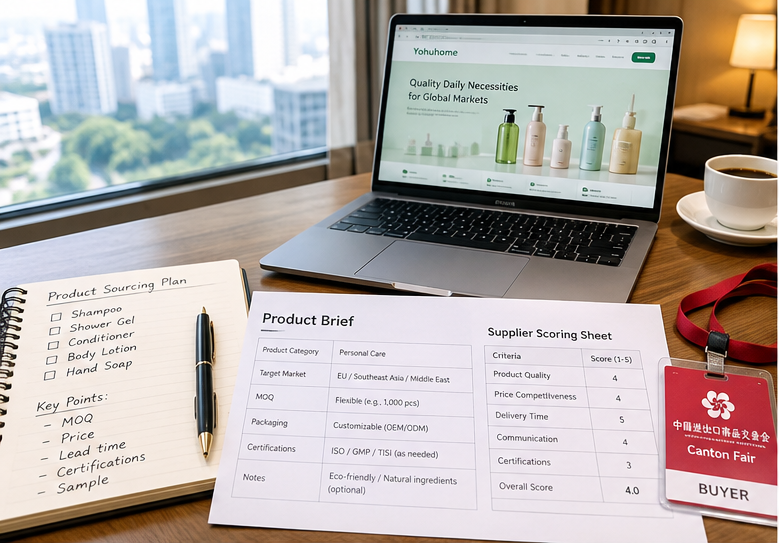
Use arrival day to get organised rather than rush the fair. Collect your badge, confirm your hotel Wi-Fi and print or download your product briefs. If you already have a target list, group suppliers by category: hair care, bath and body, laundry and household, disposable textiles. A supplier that makes shampoo may not be the best fit for disposable face towels, and vice versa.
What to prepare before you walk the floor
- A one-page brief per product category: target formula type, fragrance direction, pack size, label language and retail channel.
- A sample request template so you capture the same information from every supplier.
- A simple scoring sheet: formulation capability, packaging options, sample lead time, export experience, communication speed.
- Your business card and a clear statement of what you buy and where you sell.
If you are sourcing through an OEM/ODM partner rather than a trading company, ask early whether they formulate in-house or outsource. This affects how quickly they can respond to a custom brief and how consistently they can repeat a batch.
Day 2 — Work the Fair With a Sample-First Mindset
Treat the fair as a filtering exercise. You are not there to negotiate final terms; you are there to identify which suppliers deserve a factory visit and which samples are worth carrying home. Walk the personal care and household halls with your brief in hand and ask the same questions in the same order.
Questions that separate serious factories from booth-only traders
- Which products do you formulate and fill in your own facility, and which do you buy in?
- Can you share a sample of an existing formula close to my brief, and how long does a custom sample take?
- What packaging formats do you already run — bottles, tubes, jars, sachets, pouches, cartons?
- How do you handle labeling artwork, language variants and barcode placement?
- What export documents do you normally provide, and which ones do you not handle?
- Can I visit your factory this week or next week?
Collect samples and business cards, then rank suppliers the same evening while your notes are fresh. Mark each one as visit, sample-only, or pass. Confirm the current MOQ and lead time with our sales team or with each supplier directly, because these vary by formula, pack and season.
Day 3 — Factory Visit One: Formulation, Filling and Quality Control
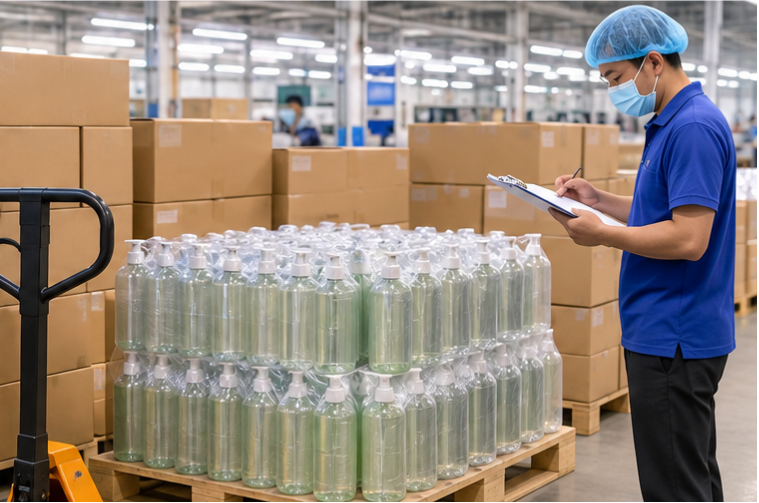
Travel to your first factory cluster. On arrival, ask for a short walkthrough rather than a presentation. You want to see the mixing area, filling lines, packing area and sample room. Pay attention to how raw materials are stored, how lines are cleaned between batches, and how finished goods are quarantined before release.
What to look for on the floor
- Batch records: can they show how a previous batch was traced from raw material to finished carton?
- In-process checks: viscosity, pH, fill weight, seal integrity, label placement.
- Changeover discipline: how do they prevent cross-contamination between fragrances or product types?
- Sample room: is there a library of existing formulas and fragrances you can smell and feel?
- Packing options: shrink wrap, cartons, display trays, polybags, private-label labeling.
Ask for the latest test documentation during sampling, and clarify which tests are routine and which are done on request. Do not assume a certificate exists for your exact formula; confirm it in writing before you place a bulk order.
End the visit with a written recap: what you saw, what you still need, and the next action. If the factory cannot answer a technical question on the spot, ask them to follow up in writing.
Day 4 — Factory Visit Two: Packaging, Labeling and Consolidation
Use the second visit for a different capability. If your first supplier is strong on formulation, look for one that is strong on packaging, labeling or household goods such as laundry detergent and disposable face towels. Many buyers split a private-label range across two suppliers to reduce risk and to match each product to the right line.
Packaging and labeling checks
- Can they source bottles, caps, pumps and tubes in the sizes you need, or do you supply packaging?
- How do they handle multilingual labels, ingredient lists, warnings and batch coding?
- What is the artwork approval process, and how many revision rounds are typical?
- Can they pack mixed SKUs into one carton or one container for consolidation?
- How do they protect goods in transit — carton strength, palletisation, moisture control?
Container loading and consolidation deserve their own conversation. Ask how they calculate carton dimensions, how they maximise container fill, and whether they can combine goods from more than one line into a single shipment. If you are working with several suppliers, a consolidation plan can reduce freight complexity, but it requires clear labeling and a packing list that matches what is actually loaded.
Day 5 — Sampling Plan, MOQ Talks and Export Documentation
Use the final day to turn visits into a concrete plan. Before you leave Guangdong, sit down with your shortlisted suppliers and agree on the sampling path, commercial terms and document flow. This is also the moment to negotiate MOQ in a realistic way.
Sampling and approval path
- Confirm the sample type: existing formula, modified formula, or fully custom development.
- Agree on sample quantity, packaging format and labeling for the sample itself.
- Ask for a realistic sampling lead time and build in time for your own testing and feedback.
- Decide who pays for samples and courier, and how the cost is handled if you place an order.
MOQ and commercial terms
- Ask what drives the MOQ: raw material minimums, bottle minimums, label printing, or line changeover time.
- Explore whether a mixed-SKU order can reach the MOQ across a range rather than per SKU.
- Confirm the current MOQ and lead time with our sales team or the supplier, as these change with materials and season.
- Clarify payment terms, deposit percentage and balance timing in writing.
Export documentation and quality consistency
- Ask which documents they prepare: commercial invoice, packing list, bill of lading, certificate of origin, and any product-specific documents required by your market.
- Confirm who is responsible for customs classification and any import permits on your side.
- Agree on a batch consistency check: retained samples, batch codes and a simple approval record for each production run.
- Ask how they handle a quality complaint, including replacement policy and root-cause follow-up.
Quality consistency across batches is the most common long-term risk in private label. The best protection is a documented specification, retained samples and a supplier that treats every batch as a repeat of the approved standard, not a new experiment.
Turning the Five Days Into a Repeatable Sourcing Process
A Canton Fair trip is most valuable when it produces a shortlist, a sampling plan and a clear next step — not just a bag of brochures. After you return, keep the same discipline: compare samples against your brief, request the latest test documentation during sampling, and confirm MOQ, lead time and documentation in writing before you commit.
If you are evaluating suppliers for shampoo, shower gel, body scrub, conditioner, body oil, disposable face towels or laundry detergent, start with a clear brief and a realistic timeline. The factory that answers your technical questions precisely and shows you a traceable batch record is usually a better long-term partner than the one that promises everything at the booth.
Ready to move from itinerary to samples? Review our manufacturing and OEM/ODM capabilities and send your product brief through our contact page, or browse the range we produce on our products page.